Showing posts with label Mid Lothian. Show all posts

Sunday, 1 June 2014

Crichton Castle

Crichton Castle is a ruin, standing alone in the hills, out of site of any other building, on a bluff above the marshy bed near the source of the River Tyne. The castle's heyday lasted for only two hundred years, it was seldom the stage for important events and was abandoned at the end of the 16th century. And yet even in its ruined state, Crichton Castle remains one of the most astonishing buildings in Scotland.


 In the 14th century John de Crichton built a tower house on the site. His son William served as Lord Chancellor of Scotland and was created Lord Crichton in c.1443. He had been partly responsible for organizing the infamous 'Black Dinner' of 1440 when the young Earl of Douglas was murdered. As a consequence he obtained the Douglas property of Bothwell Castle in Lanarkshire. In retaliation a Douglas loyalist attacked Crichton in 1445. William not only made good the damage but extended the castle and built the nearby collegiate church.  But the 3rd Lord Crichton Castle made the mistake of supporting the Duke of Albany and as a result, lost his land and titles which were forfeit in 1483.

                                   
In 1488 James IV granted Crichton Castle to James Hepburn, later 1st Earl of Bothwell. The 2nd Earl died at Flodden in 1513. The 3rd Earl conspired with the English against the Scottish Crown but eventually made his peace with the regent Mary of Guise. When the 4th Earl of Bothwell sided with the Catholic Mary of Guise during the Scottish Reformation, Regent the Earl of Arran attacked and captured Crichton on 3rd November 1560.

                                   
Crichton Castle was the venue for a glittering social occasion on 4th January 1562, the marriage of Jean Hepburn to John Stuart, Lord Darnley, illegitimate son of James V, whose half sister Mary Queen of Scots attended the festivities.


The Earl of Bothwell was implicated in the murder of Mary's second husband Henry Stuart, Lord Darnley, in February 1567,  and became Mary's third husband in May of that year. By December all Bothwell's estates, including Crichton and his titles, were forfeited.


In 1568 Bothwell's estates, including Crichton, were granted to Francis Stewart, son of John Stewart Lord Darnley, and Jean Hepburn, therefore grandson of James V. Francis was created Earl Bothwell in 1577. He was a highly cultured and educated man who traveled widely in Europe, and inspired by what he had seen built the ultra-modern Italianate North range at Crichton in the 1580's.


Francis Stewart entertained James VI at his astonishing new lodging in March 1586. The king himself a cultured man must have been suitably impressed. But the Earl's volatile and impetuous nature propelled him into exile in 1595 and he never  returned to Scotland. We are incredibly lucky that the King's order to raise the castle was never carried out. But Crichton ceased to be a lordly residence. Although the castle was restored to his son, also Francis, he was shackled by debt and sold up. By 1659 the stones of Crichton  were being carried away for use in other buildings.

In Marmion, Sir Walter Scott described the neglected ruins:

             Crichton! though now they miry court
             But pens the lazy steer and sheep

But interest in the ruins generated by the publication of Marmion led to Crichton being valued again and in 1926 the still splendid ruined castle was handed over to the care of the State.

Friday, 14 February 2014

David Rizzio's Tree

David Rizzio was an Italian nobleman from Piedmont who came to Scotland in 1561 in the entourage of an ambassador.  An accomplished musician and an excellent singer he came to the notice of Mary, Queen of Scots when she was looking to recruit a bass singer. He was wanted to accompany  her three ladies- in -waiting who sung the soprano parts, to form a vocal quartet. Then in 1564 when the previous incumbent retired, Mary appointed David Rizzio as her secretary for relations with France, an important position that came with an quarterly salary of £20

Rizzio wanted  a country retreat to reflect his important position at court. The Queen tried to persuade Lord Ross to give her secretary the lordship of Melville. Although he did not agree to this request, David Rizzio was able take apartments in the castle outside Edinburgh, and so Melville Castle became known to locals as 'Rizzio's House'. The Queen was a frequent visitor.

On one of Mary's visits Rizzio planted a tree, a sweet chestnut (castanea sativa)  in the grounds of the castle, as a token of his affection. The tree has survived 450 years, a magnificent specimen of enduring love. In response, the Queen planted five oak trees along the drive.


Such public displays of affection as the planting of this tree were to lead to David Rizzio's downfall. The Protestant lords, managed to persuade her husband, Lord Darnley, that the Catholic Rizzio was not only the Queen's lover but was responsible for her pregnancy. In 1566 they broke into the Queen's apartments at Holyrood and stabbed him, 57 times. A few years later Darnley was himself murdered, by among others the Queen's new lover, the Earl of Bothwell. Mary was accused of complicity in Darnley's murder and as a consequence was taken capture and forced to abdicate her throne..Although Mary managed to escape, to England, after many years of imprisonment she was executed by her cousin Elizabeth. The venerable sweet chestnut at Melville Castle remains as an enduring symbol of the Queen's and Rizzio's ill-fated mutual affection.


Saturday, 11 January 2014

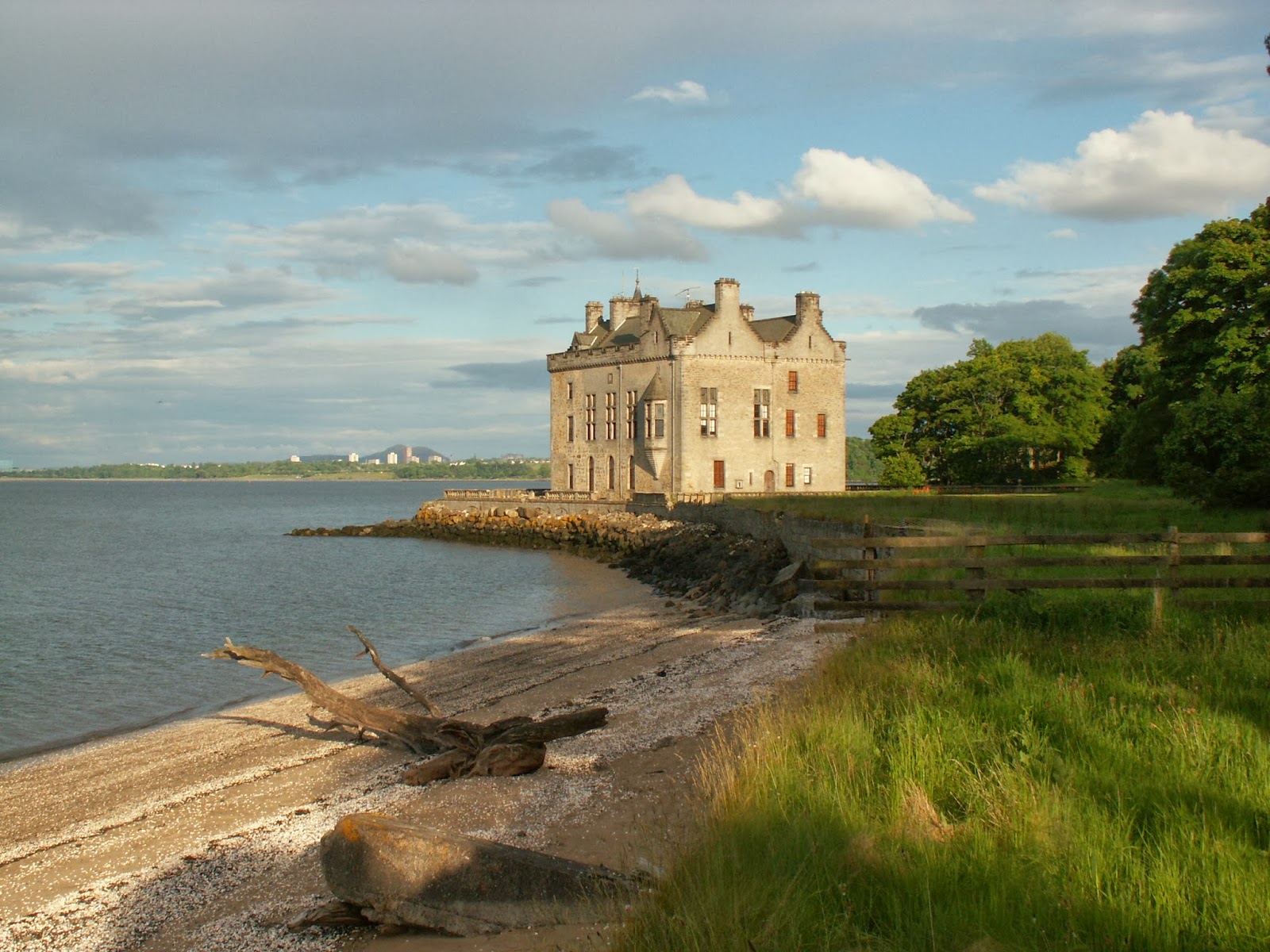
Barnbougle Castle

Barnbougle Castle stands on the shore of the Firth of Forth in the policies of Dalmeny House near South Queensferry. The original castle which dated from the 13th century was built by the Mowbray family who in 1615 sold it to the Hamilton earls of Haddington. The Hamiltons later sold it to the Primrose family in 1662. Barnbougle Castle became the seat of the Primrose earls of Rosebery until Dalmeny House was completed in 1817. By then Barnbougle had fallen into a serious state of dilapidation and disrepair. One story is told that on a particular  evening during supper, a large wave crashed in through the dining room windows. Presumably that was the final straw. After the family had moved out the building was used to store explosives. An accidental explosion left the castle in ruins.


The ruins were rebuilt  around 1880 by Archibald Primrose, 5th Earl of Rosebery. He was foreign secretary in 1886 and again from 1892-94 and prime minister from 1894-95. Lord Rosebery was a supporter of Scottish Home Rule. The prime minister used Barnbougle Castle to house his private library and it was here that he used to write and practice delivering his speeches, in a specially constructed gallery.


Wednesday, 8 January 2014

Rosebery Steading

In 1805 the earl of Rosebery built himself a new farmyard. To create the greatest impact the steading was placed opposite the main gates to Rosebery House, the earl's principal  seat  in Mid-Lothian.. The steading is arranged around an enclosed courtyard. Opposite the  entrance,  the clock tower incorporates a doocot and has a fantastic tall spire. The screen walls are castellated in the Gothick style. Rosebery Steading is one the of the finest and most iconic farm steadings in Scotland.