'Weeping Girls' is a haunting , harrowing and yes, disturbing, installation of painted bronze figures in Gala Hill Wood at Jupiter Artland. The figures were carved in wax by Laura Ford. They were cast in found objects at the foundry.
"The site I have picked at Jupiter has a quiet, melancholic atmosphere."
Showing posts with label Edinburgh. Show all posts
Friday, 16 January 2015
Tuesday, 25 November 2014
Jupiter Artland, "Temple of Apollo"
The Temple in Gala Wood At Jupiter Artland is built from Portland stone and embellished with gold leaf lettering by Ian Hamilton Finlay. The quote ' Consecutive upon Apollo a titanic revolt in his heart' is from L.A. St-Juste, Finlay's 'Apollo of the French Revolution'
"Temple (n): a sacred place; a place menaced by bailiffs."
Saturday, 7 June 2014
Jupiter Artland, "Rivers"
'Rivers' is a wonderful, extraordinary and very, very beautiful installation by Tania Kovats. It is a boathouse built over the Duck Pond at Jupiter Artland.
Inside the boathouse is a collection of water from one hundred rivers around the British Isles.
"Each river has a history and each river has a story and in some way I am trying to capture that in each bottle."
Inside the boathouse is a collection of water from one hundred rivers around the British Isles.
"Each river has a history and each river has a story and in some way I am trying to capture that in each bottle."
Sunday, 1 June 2014
Crichton Castle
Crichton Castle is a ruin, standing alone in the hills, out of site of any other building, on a bluff above the marshy bed near the source of the River Tyne. The castle's heyday lasted for only two hundred years, it was seldom the stage for important events and was abandoned at the end of the 16th century. And yet even in its ruined state, Crichton Castle remains one of the most astonishing buildings in Scotland.
In the 14th century John de Crichton built a tower house on the site. His son William served as Lord Chancellor of Scotland and was created Lord Crichton in c.1443. He had been partly responsible for organizing the infamous 'Black Dinner' of 1440 when the young Earl of Douglas was murdered. As a consequence he obtained the Douglas property of Bothwell Castle in Lanarkshire. In retaliation a Douglas loyalist attacked Crichton in 1445. William not only made good the damage but extended the castle and built the nearby collegiate church. But the 3rd Lord Crichton Castle made the mistake of supporting the Duke of Albany and as a result, lost his land and titles which were forfeit in 1483.
In 1488 James IV granted Crichton Castle to James Hepburn, later 1st Earl of Bothwell. The 2nd Earl died at Flodden in 1513. The 3rd Earl conspired with the English against the Scottish Crown but eventually made his peace with the regent Mary of Guise. When the 4th Earl of Bothwell sided with the Catholic Mary of Guise during the Scottish Reformation, Regent the Earl of Arran attacked and captured Crichton on 3rd November 1560.
Crichton Castle was the venue for a glittering social occasion on 4th January 1562, the marriage of Jean Hepburn to John Stuart, Lord Darnley, illegitimate son of James V, whose half sister Mary Queen of Scots attended the festivities.
The Earl of Bothwell was implicated in the murder of Mary's second husband Henry Stuart, Lord Darnley, in February 1567, and became Mary's third husband in May of that year. By December all Bothwell's estates, including Crichton and his titles, were forfeited.
In 1568 Bothwell's estates, including Crichton, were granted to Francis Stewart, son of John Stewart Lord Darnley, and Jean Hepburn, therefore grandson of James V. Francis was created Earl Bothwell in 1577. He was a highly cultured and educated man who traveled widely in Europe, and inspired by what he had seen built the ultra-modern Italianate North range at Crichton in the 1580's.
Francis Stewart entertained James VI at his astonishing new lodging in March 1586. The king himself a cultured man must have been suitably impressed. But the Earl's volatile and impetuous nature propelled him into exile in 1595 and he never returned to Scotland. We are incredibly lucky that the King's order to raise the castle was never carried out. But Crichton ceased to be a lordly residence. Although the castle was restored to his son, also Francis, he was shackled by debt and sold up. By 1659 the stones of Crichton were being carried away for use in other buildings.
In Marmion, Sir Walter Scott described the neglected ruins:
Crichton! though now they miry court
But pens the lazy steer and sheep
But interest in the ruins generated by the publication of Marmion led to Crichton being valued again and in 1926 the still splendid ruined castle was handed over to the care of the State.
Tuesday, 15 April 2014
Jupiter Artland, "The Light Pours Out Of Me"
An underground chamber of amethyst surrounded by obsidian in its natural state,
protected by gold barbed wire.
Jupiter Artland, "Stone House - Bonnington"
Stone house made from locally quarried stone by Andy Goldsworthy.
"Houses are usually places of security, shelter and comfort. There is something unnerving about entering a building in which nature is the occupant."
Thursday, 3 April 2014
Jupiter Artland, "Over Here"
Over Here by Shane Waltener is a giant web. It was knitted with circular knitting needles and four strands of multi -coloured fishing line, using a technique inspired by Shetland lace.
"Trapping the essence of the place and framing an ever changing imprint of it."
Wednesday, 26 February 2014
Dalkeith Old Wood
Dalkeith Old Wood is another precious fragment of the 'wild wood' in lowland Scotland. Like the Cadzow Oaks, Dalkeith Old Wood is bounded on two sides by rivers. It lies between the North Esk and the South Esk before their confluence at a place known as the Meeting of the Waters. The Old Wood in effect covers a peninsula with an incredibly rare landscape of remarkable oak trees. Only six miles from the centre of Edinburgh,Dalkeith Old Wood remains a secretive place.
When King James VI received news of his mother's death on 8th February 1587,at Fotheringay in England, he retired early to his private apartments at Holyrood, without even eating supper. The next day he rose early and rode to Dalkeith, passing the site of his father's murder at Kirk O' Fields and on to the place he loved and knew so well. Dalkeith had been the seat of the regent of Scotland during his minority. It was to Dalkeith and its beautiful park that the King sought the solitude in which to grieve for his mother. Though he grieved in private, publicly he was obliged to remain on good terms with Queen Elizabeth as her heir presumptive. He would inherit the English throne one day and be able to avenge his mother in that way.
Tuesday, 4 February 2014
Jupiter Artland, "Landscape with Gun and Tree 2010"
Landscape with Gun And Tree 2010 by Cornelia Parker.
"In Gainsborough's, Mr and Mrs Andrews, a couple are posed under a tree, Mr Andrews carries a shotgun under his arm and his wife sits with her (unfinished) hands in her lap. In Landscape with Gun and Tree, a gun has been left leaning against a tree, possibly loaded."
Sunday, 12 January 2014
King Tom
King Tom (1851-1878) was the foundation stallion of Baron Meyer de Rothschild's stud at Mentmore. Foaled in 1851 he was by Harkaway out of Pochohontas by Glencoe. A thoroughbred he won races as a two year old and when not fully recovered from injury he was second, by a length, to Andover in the Derby. He raced again as a four year old before breaking down and being retired to stud.
Between 1861 and 1871 he was one of the top ten sires fourteen times and leading sire in Great Britain and Ireland in 1870 and 1871. He sired the 1866 and 1867 Oaks winners Tormentor and Hippia, and the 1870 Derby winner Kingcraft. He sired the 1864 Oaks winner Tomato and Hannah who won the Oaks, 1000 Guineas and the St. Ledger.
When he died at the age of twenty seven in 1878 he was buried in the grounds of Mentmore Towers beneath a life size bronze statue of him by sculptor, Ernst Boehm. When the Primrose family sold Mentmore Towers the statue was removed to Dalmeny where it now stands in the policies beside the house.
Saturday, 11 January 2014
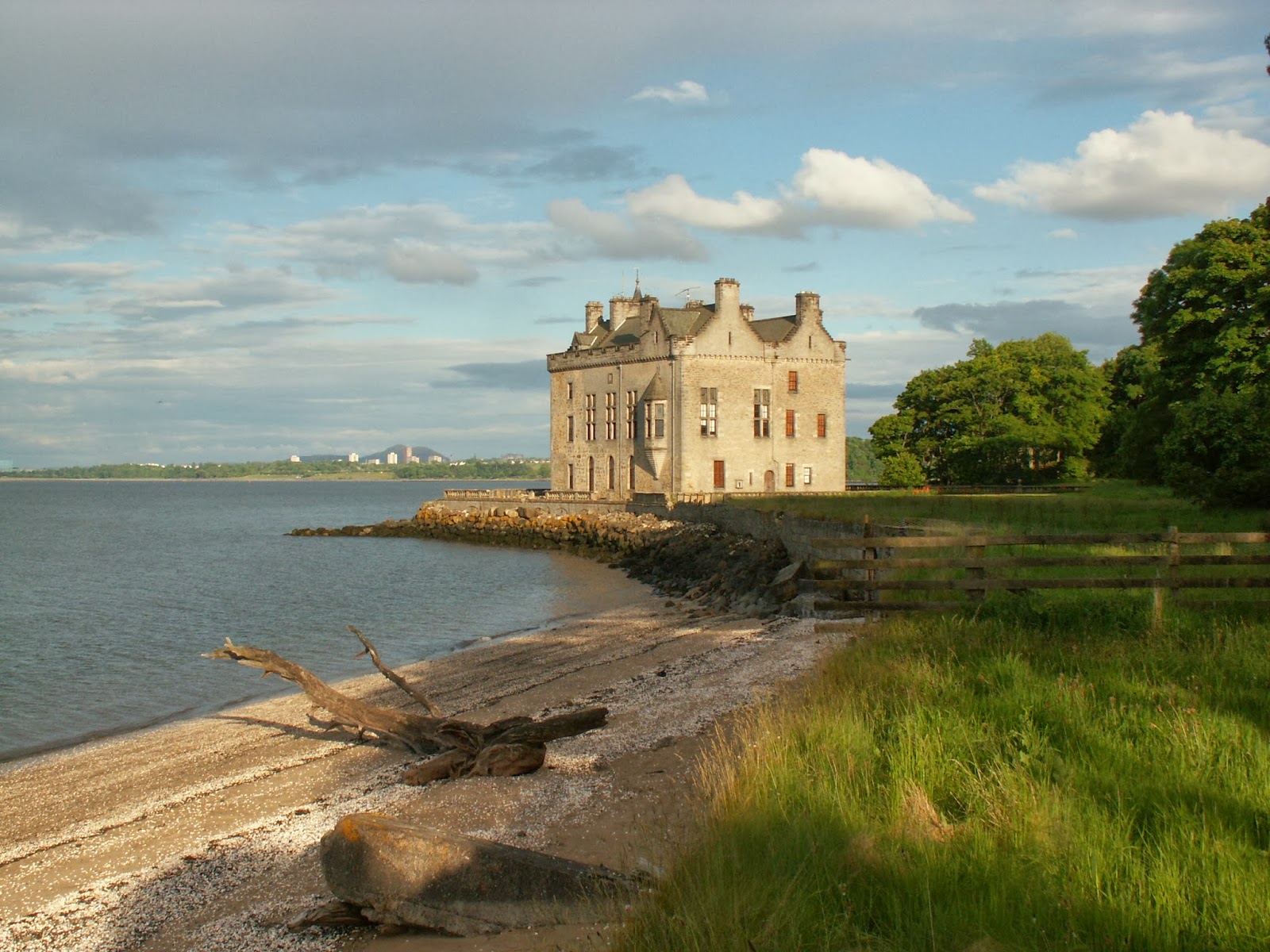
Barnbougle Castle
Barnbougle Castle stands on the shore of the Firth of Forth in the policies of Dalmeny House near South Queensferry. The original castle which dated from the 13th century was built by the Mowbray family who in 1615 sold it to the Hamilton earls of Haddington. The Hamiltons later sold it to the Primrose family in 1662. Barnbougle Castle became the seat of the Primrose earls of Rosebery until Dalmeny House was completed in 1817. By then Barnbougle had fallen into a serious state of dilapidation and disrepair. One story is told that on a particular evening during supper, a large wave crashed in through the dining room windows. Presumably that was the final straw. After the family had moved out the building was used to store explosives. An accidental explosion left the castle in ruins.
The ruins were rebuilt around 1880 by Archibald Primrose, 5th Earl of Rosebery. He was foreign secretary in 1886 and again from 1892-94 and prime minister from 1894-95. Lord Rosebery was a supporter of Scottish Home Rule. The prime minister used Barnbougle Castle to house his private library and it was here that he used to write and practice delivering his speeches, in a specially constructed gallery.
Wednesday, 4 December 2013
Jupiter Artland, "Suck"
Suck is a work by Anish Kapoor, an opening in the ground plated with cast iron walls barred by a seventeen-foot high cast iron cage
.
.
"we all know what darkness is ...we carry it within us."
Subscribe to:
Posts (Atom)